Rony - My Non-Fungible Token

Moore's Law is a prediction made by Gordon Moore, the co-founder of Intel, in 1965 that the number of transistors on a microchip would double approximately every two years, while the cost per transistor would decrease. This prediction was based on Moore's observation of the trend in the development of computer technology from the late 1950s to the mid-1960s, and it has been remarkably accurate for several decades.
The doubling of transistors on a microchip has enabled the development of more powerful and efficient computer processors and has contributed to the rapid advancement of computing technology over the past several decades. Moore's Law has been a driving force behind the development of smaller, faster, and more energy-efficient devices such as smartphones, laptops, and servers.
While there has been some debate about the continued validity of Moore's Law as transistor sizes approach the limits of physics, it remains a guiding principle for the semiconductor industry and a symbol of the remarkable progress that has been made in computer technology over the past several decades.
I believe this prediction has held true and will continue to do so even for another 1000s of years. As we stand, live, and breathe, we are in the era of technology in which even the smallest child has access to a smartphone or tablet. Transistors and semiconductor technology will continue to evolve, the question is at what cost, what is being lost and gained.
The S-Curve model is a tool used to describe the growth of a technology or a product over time. The model is named after its characteristic shape, which resembles the letter "S". The S-Curve model suggests that a technology or a product will experience a period of slow growth, followed by a period of rapid growth, and then a period of slower growth as the technology or product reaches maturity.
In the context of emergency management, the S-Curve model can be used to describe the adoption and impact of new technologies in the field. For example, a new technology such as drones or artificial intelligence (AI) may experience slow growth as it is introduced and tested, followed by rapid growth as it gains wider acceptance and is integrated into emergency management practices. As the technology matures and becomes more widely adopted, its growth may slow down as it becomes more commonplace.
The impact of technology on emergency management can be significant. For example, the use of drones can provide real-time information about disaster areas, allowing emergency responders to assess the situation and make decisions more quickly and accurately. AI can be used to analyze data from a variety of sources, such as social media and satellite imagery, to provide early warning of potential disasters and identify areas that may be particularly vulnerable.
Other technologies, such as mobile applications and social media, can be used to communicate with the public and provide real-time updates about emergency situations. In addition, the use of advanced modeling and simulation tools can help emergency managers predict the potential impact of disasters and develop effective response plans.
Overall, the adoption of new technologies has the potential to revolutionize the field of emergency management and improve the ability of responders to prepare for and respond to disasters. As the S-Curve model suggests, the impact of these technologies is likely to grow rapidly in the coming years, and emergency management professionals will need to stay up to date with the latest developments in order to take full advantage of their potential benefits.
As a current emergency manager, my organization responded to 2500 residential and commercial emergencies from the devastation of Hurricane Ian. During the initial phase as roads were flooded it was nearly impossible to get in for a couple of days to start assisting in the disaster response. With the use of our drones, we were able to capture a more accurate picture of the devastation and what safety precautions were needed as well as any special equipment in order to give some type of relief if a house had a damaged roof or a tree fell on a structure of the house.
In recognition of Black History month, I used this timeline as my infographic. Although there are only few names on this timeline, there are thousands more that helped pave the way.
.jpg)
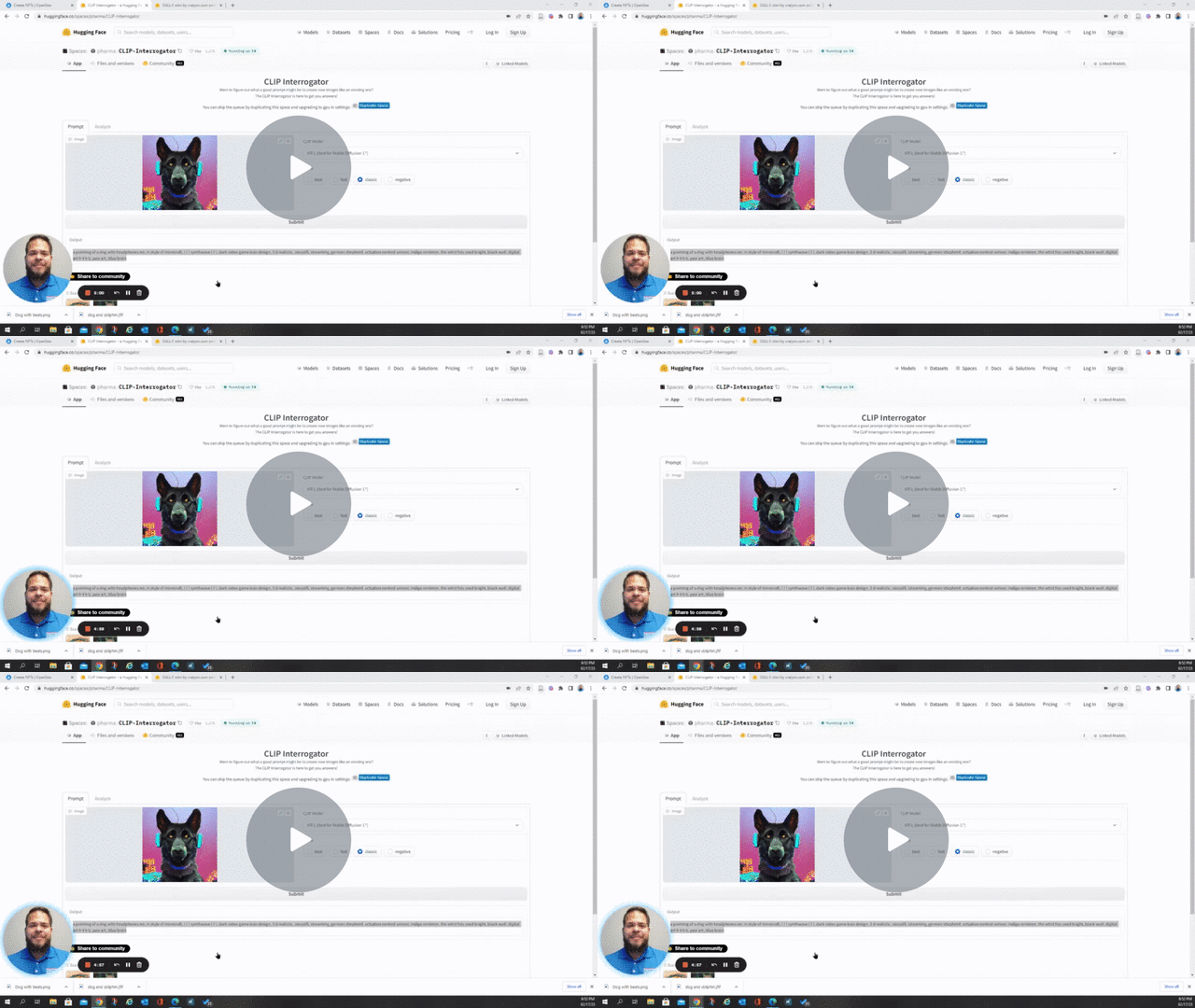
CLIP Interrogator - a Hugging Face Space by pharma - 17 February 2023 - Watch Video

Before Writing:
As I sat down to begin this blog, I felt a sense of anxiety and nervousness of having the process down to create my first-ever NFT. As I continued attempting at creating various NFT of our black German Shepard I was starting to feel in my heart some thoughtful memories of the great life Rony had. Despite these feelings, I know that writing is a process and that I just need to take it one step at a time and that maybe what I do with this new image, will also bring some peace and joy to my daughter.
During Writing:
As I began to write, I felt a sense of satisfaction in being able to even write a novice-like blog. I still feel my writing is too straightforward, as I am normally not a person that likes to express feelings and emotions on paper. I do get frustrated with the organization and streamlining the blog as sometimes I think it doesn't flow well.
After Writing:
After writing this blog and sharing my experience, I felt joy and happiness that I did create an NFT and I have been actually using more often these new technological tools not only in my personal life but also for work. I know I will never be a writer, publisher, or blogger with thousands of followers. There may be some regret that I didn't read and write more, which would have made me a better communicator and person.
My ChatGPT experiences:
I used ChatGPT to initially learn about Moore's Law and the S-Curve as well as the internet. I do have a great level of satisfaction with ChatGPT with the information provided. I can honestly say that I am starting to depend on ChatGPT way more than ever before, and this will be a dangerous road that I will thread. I do see the benefits, but I have to remind myself to not be dependent. Since I have used Chat GPT more and more, I have even joined their LinkedIn page and Facebook page for tips and tricks, and now it's even a shortcut on my phone. I will continue to affirm the ethical dilemma of students and perhaps professionals of solely using ChatGPT to communicate, get information and deliver a paper or a blog. I only did some minor modifications to what ChatGPT provided with Moore's Law and S-Curve.
Prompts:
-Explain what is Moore's law?
-Explain the S-Curve model and share the impact technology will have in the emergency management field
-Explain technology laws to enable you why technology develops so fast and what are the laws to propel these rapid developments. Moreover, it is critical for you to learn how to spot a change through models such as the S-Curve.
In summary, technology will continue to evolve, and I agree with Moore's law, the use of technology in everyday life experiences as well as your professional life will get even more robust and mesmerizing. Creating an NFT is not as complicated as I initially thought. I am actually very happy that I am taking this class and is sparking something within me.


Thank you for sharing your thoughts on Moore's Law, the S-Curve model, and the impact of technology on emergency management. I agree that these models can provide valuable insight into the growth and adoption of new technologies in various fields. Your personal experience using drones during Hurricane Ian highlights the potential benefits of these technologies in emergency response situations. Great post!
ReplyDelete